
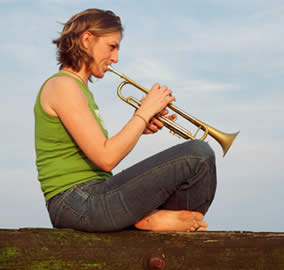
Note by Note, Beat by Beat: The Ingrid Jensen InterviewIngrid Jensen went on a boat ride up the Alaskan coast for her honeymoon. The resultant CD, At Sea, is filled with amazing images and textures not normally associated with the trumpet and she tells Earshot's Jim Dupuis how that evolved.Jim Dupuis 1 of 2 Next>
JD: Maybe you could tell us a little bit about yourself and how you first got into music. IJ: Well, I grew up on Vancouver Island , just outside of Nanaimo . My mother was a piano player and she had a lot of great, interest in jazz from her early days at UBC, when she hung out with Linton Garner and a bunch of others in the young jazz crowd there, back in the day. She turned my sister and me on to a lot of really good music at a very young age and when I came out of the womb I already knew who Louis Armstrong was and I wanted to know more. Growing up in Nanaimo -at first when I got there, there weren't really a lot of band programs, but when my family transplanted there, there seemed to be this boost of music programs in the school. It was a really great time when all the band teachers actually were playing and as well as teaching. It still kind of exists, but back then when I was growing it was really happening and that's how I was exposed to a lot of playing situations at an early age. That's really how I got into it, through the school music system. JD: You definitely have your own voice with the trumpet. When I listen to it, sometimes I hear some Miles Davis in there, though I could be wrong. Who influenced you the most in your formative years? Anybody, or did you just pick it up? IJ: Everybody is an influence-from Joni Mitchell to k.d. lang to Ella Fitzgerald-they are all singers of course, but I think that's the feminine part of my love of music that I have managed to, or at least I'm trying to transport into the jazz language of it all. It's just any good music that comes my way. Of course Miles (Davis), Freddie Hubbard, Clifford Brown and all those great players were very influential on my approach to playing the trumpet, but I was also listening to other types of music when I was growing up, as well-now more than ever. Everything that's good comes my way. I check it out. JD: Speaking of the gender "thing", it was once said that if a woman showed up to a jazz gig she would be told, "The piano's over there." How have you found things as a trumpet player with the boys? IJ: Well you think it would change more being in the year 2006, but as much as I try to be the Pollyanna of the situations, that surround this whole very, very male boys club jazz environment. It's still a fact that most of the festivals are run by men, they book men. Most of the magazines advertise men, you know, you get the picture. I kind of feel like Al Gore, with his new movie, where you have to be yourself and get into the trenches and just do your thing one city at a time and that's something that I feel fortunate that I've been able to do, up to this point in my life. It's been touring and playing and really being accepted by audiences without having to push my work into anyone's face and I feel fortunate in that way to have grown up in such an organic environment. I think British Columbia has helped me survive the strange, political amount of garbage that goes on in the jazz world, because there is a lot. I'm not interested in talking about the women in jazz thing, because when people make a big deal about it, they are doing it to get it over with to get the women out of the way so they can get the music back to the boys. I've seen that a lot with "women in jazz" festivals. As good as they can be with integrity, they get more women involved, but they end up ghettoizing the situation, rather than JD: I hope so, too. IJ: That there will be more fairness (laughs). JD: We are seeing more women playing in Canada . In Toronto there are a few women that I have spoken with, that are putting out CDs and getting some decent gigs at the jazz festivals and they are in bands that include both males and females and like you say that's the way it should be. IJ: I think Canada is in better shape than most of the world. Growing up in Canada helped me to become not too afraid of just taking a risk and doing something strange. Apparently I'm the first one to emblazon a career-there's a picture of me in the American Museum of Natural History-I don't know why (laughs), but there is- JD: Cool. IJ: and it's just a cool thing to know that young women get exposed to that, and I'm all for it and again I think that in Canada there's a little more support for people for people to be artists and that allows women to do their thing. At the same time, within the school systems, it's going to take a lot of time to change and it is going to take new teaching. If they see a young girl, who has a spark, but she's shy and the teacher sets them up to play a solo, so they will understand what it's like to play a solo and they don't feel so insecure, because, if you know anything about young boys in their teens, they don't care. They don't care if they sound like Ornette (Coleman) on a really bad day or John Coltrane on the best day. They're just going for it. Guys have a much easier time exposing themselves and sounding bad and not worrying about it. Women on the other hand tend to be a little more "sensitive." That's my experience. JD: Ingrid, you've put out a nice body of work and I believe you have also been in Maria Schneider's Big Band. You've been in big bands, small bands and you compose and do a whole bunch of other stuff, so how do you see your music evolving? IJ: Note by note, beat by beat. I don't know. It's such a wild animal, being in the scene that I'm in, in New York , because I'm playing with musicians at such a high level who are also-there's not so many working bands anymore-I'm not out with my band working 50-60 gigs a year anymore. We get together and play three to four times, maybe ten times a year. The guys in my band are all doing other projects, so every time I bring in new music for them or take my music to other people to play, it's going to be so different and it's going to evolve depending upon the level of the players. So in New York I'm kind of in a position where I keep pushing and striving to evolve, deeper and deeper and staying in touch with what's going on, rather than just gravitating towards some style that works. It's kind of difficult to explain, but hopefully your listeners get the point. JD: I think they will. IJ: It's an evolutionary thing. I can't say that I have one concept. I went to Peru and I heard Afro-Peruvian music, not the Andean, but the real deep African tradition and that had a huge impact on me. I ended up just writing some rhythms and then I wrote a piece over based on those rhythms. The same thing happens when I got into the city and I hear a band playing more funk music or a little more "out" and that will influence me as well. So it's really as I said-note by note, day to day. You never know what is going to influence my ideas. JD: Well, I think something that influenced your new CD, would be the sea (laughs) . IJ: For sure. 1 of 2 Next> |
Reviews
Mngwa

Andrew Franey
The Shangs
Alex Cuba
Tri Nguyen
Defend The Rhino

Talltale

Kiwi Jr.
Plaster

Hyness
Black Suit Devil
Yamantaka // Sonic Titan
The Pack A.D.
Chad VanGaalen
Potengowski Anna Friederike
Todd Rundgren
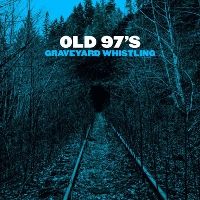
Old 97's
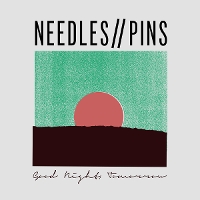
Needles//Pins
This Month
!earshot Top 200 of 2021For January to December 2021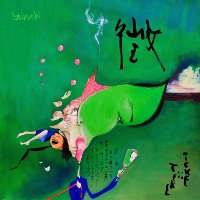
|
|||
| TW | Artist - Title - (Label) | ||
|---|---|---|---|
| 1 | TEKE::TEKE 
Shirushi - (Kill Rock Stars) |
||
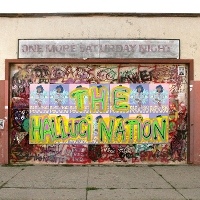
| 2 | The Halluci Nation
One More Saturday Night - (Radicalized) |
||
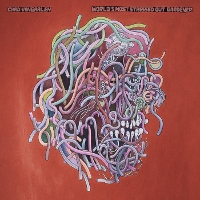
| 3 | Chad VanGaalen
World's Most Stressed Out Gardener - (Flemish Eye) |
||
| 4 | The Weather Station
Ignorance - (Next Door) |
||
| 5 | Kiwi Jr.
Cooler Returns - (Kiwi Club) |
||
| 6 | Arlo Parks
Collapsed In Sunbeams - (Transgressive) |
||
| 7 | Ada Lea
one hand on the steering wheel the other sewing a garden - (Next Door) |
||
| 8 | Sook-Yin Lee & Adam Litovitz
jooj two - (Mint) |
||
| 9 | Suuns
The Witness - (Secret City) |
||
| 10 | Andy Shauf
Wilds - (Arts & Crafts) |
||
|
View the full !earshot Top 200 |
|||
| Specialty Charts #1s | |||
| Electronic: | The Halluci Nation - One More Saturday Night - (Radicalized) | ||
| Hip Hop: | Cadence Weapon - Parallel World - (Self-Released) | ||
| International: | Lakou Mizik and Joseph Ray - Leave The Bones - (Anjunadeep) | ||
| Jazz: | Adrian Younge - The American Negro - (Jazz Is Dead) | ||
| Loud: | Tunic - Exhaling - (Artoffact) | ||
| Folk/Roots/Blues: | Allison Russell - Outside Child - (Fantasy) | ||
 I think British Columbia has helped me survive the strange, political amount of garbage that goes on in the jazz world, because there is a lot. I'm not interested in talking about the women in jazz thing, because when people make a big deal about it, they are doing it to get it over with to get the women out of the way so they can get the music back to the boys.


